Note
Go to the end to download the full example code.
Extending LION
Each piece of LION is a small base class over plain torch, and each can be your own: an operator, a model, a dataset, a reconstructor, a solver. Written as LION’s are, yours get what LION’s have: records, saving and loading, evaluation, publishing.
This tutorial builds a problem LION doesn’t have, deblurring: a blur operator, a dataset of blurred images, an unrolled model for it, and a reconstructor, then trains and uses them with LION’s solver. To add them to LION itself, see the contributor guide.
Previous: Publishing and reproducing.
Needs a GPU and the processed LIDC-IDRI data in LION_DATA_PATH (the images
to blur).
Note
The models trained in these tutorials are toys: a few epochs on a few slices, to show how LION is used, so their results are poor (often worse than FDK). Trained as their papers train them (many epochs, all the data), they do what the papers report.
An operator
An operator derives from Operator and defines forward (and
__call__, which calls it), adjoint, its domain_shape and
range_shape, and, if it can be differentiated, autograd(); if it has
a usual reconstruction, default_reconstruction_fn(). It is made by its
parameters, an OperatorParameters, which is what models, solvers and
records take (as they take a CT geometry).
import tempfile
from pathlib import Path

import matplotlib.pyplot as plt
import torch
import torch.nn.functional as F
from torch.utils.data import DataLoader

from LION.operators.Operator import Operator
from LION.utils.parameter import LIONParameter, OperatorParameters


def blurred_image(y, op):
    """The blur's default reconstruction: the blurred image as it is."""
    return y


class Blur(Operator):
    """A Gaussian blur of images (1, H, W), by convolution with zero padding:
    the kernel is symmetric, so the blur is its own adjoint."""

    def __init__(self, parameters):
        super().__init__()
        self.parameters = parameters
        size, sigma = parameters.kernel_size, parameters.sigma
        t = torch.arange(size) - size // 2
        g = torch.exp(-(t**2) / (2 * sigma**2))
        self.kernel = (g[:, None] * g[None, :] / g.sum() ** 2)[None, None]

    def __call__(self, x, out=None):
        return self.forward(x)

    def forward(self, x):
        batched = x.dim() == 4  # (B, 1, H, W), or one image (1, H, W)
        x = x if batched else x[None]
        y = F.conv2d(x, self.kernel.to(x), padding=self.parameters.kernel_size // 2)
        return y if batched else y[0]

    def adjoint(self, y):
        return self.forward(y)

    @property
    def domain_shape(self):
        return tuple(self.parameters.image_shape)

    @property
    def range_shape(self):
        return tuple(self.parameters.image_shape)

    def autograd(self):
        # only torch operations: torch differentiates it as it is
        return self, self.adjoint

    def default_reconstruction_fn(self):
        return blurred_image


class BlurParameters(OperatorParameters):
    """The blur's parameters, which make it."""

    def make_operator(self):
        return Blur(self)


blur = BlurParameters(kernel_size=9, sigma=2.0, image_shape=[1, 512, 512])
A dataset
A dataset derives from LIONDataset (a torch Dataset) and keeps its
constructor’s arguments as attributes of the same names, so its record can
say how to make it again. Listing its samples (sample_ids()) and their
groups (sample_groups(), e.g. patients, which must stay in one split)
lets records and evaluations check what was trained and tested on. Its
random numbers come from seeded(seed, sample): each sample is the same
every time it is read.
from LION.data_loaders.LIDC_IDRI import LIDC_IDRI
from LION.data_loaders.LIONDataset import LIONDataset
from LION.utils.rng import seeded


class BlurredLIDC(LIONDataset):
    """LIDC-IDRI slices blurred by the blur of ``operator_params``, with
    Gaussian noise of standard deviation ``parameters.noise``: (blurred image,
    image) pairs. ``mode``: "train", "validation" or "test"."""

    def __init__(self, mode, operator_params, parameters=None):
        self.mode = mode
        self.operator_params = operator_params
        self.parameters = (
            parameters if parameters is not None else self.default_parameters()
        )
        self.images = LIDC_IDRI(mode)
        self.op = operator_params.make_operator()

    @staticmethod
    def default_parameters():
        return LIONParameter(noise=0.01, seed=0)

    def __len__(self):
        return len(self.images)

    def __getitem__(self, index):
        image = self.images[index][1]
        with seeded(self.parameters.seed, self.sample_ids()[index]):
            noise = torch.randn(image.shape)
        return self.op(image) + self.parameters.noise * noise.to(image), image

    def sample_ids(self):
        return self.images.sample_ids()

    def sample_groups(self):
        return self.images.sample_groups()


training = torch.utils.data.Subset(BlurredLIDC("train", blur), range(40))
validation = torch.utils.data.Subset(BlurredLIDC("validation", blur), range(8))
training_loader = DataLoader(training, batch_size=4, shuffle=True)
validation_loader = DataLoader(validation, batch_size=4)
/mhome/damtp/r/ab2860/AItomotools/LION/data_loaders/LIDC_IDRI.py:487: UserWarning: LIDC-IDRI: left out 2 damaged or unusable files (re-run the pre-processing for these patients): ['LIDC-IDRI-0238 (not resampled)', 'LIDC-IDRI-0585 (not resampled)']
  warnings.warn(
A model
A model derives from LIONmodel. One that uses an operator takes its
parameters first and its own second, and makes the operator (with
autograd=True to differentiate through it: self.A, self.AT).
default_parameters() lists every setting, with model_input_type:
what it takes. A model from a paper defines cite().
Here, learned gradient descent: K steps x ← x - CNN(x, Aᵀ(Ax - y)), from the operator’s default reconstruction.
from LION.models.LIONmodel import LIONmodel, LIONModelParameter, ModelInputType


class LearnedGradientDescent(LIONmodel):
    """``n_steps`` learned gradient steps, each a small CNN of the image and
    the data fit's gradient."""

    def __init__(self, operator_params, model_parameters=None):
        super().__init__(model_parameters, operator_params)
        self._make_operator(autograd=True)
        channels = self.model_parameters.channels
        self.steps = torch.nn.ModuleList(
            torch.nn.Sequential(
                torch.nn.Conv2d(2, channels, 3, padding=1),
                torch.nn.ReLU(),
                torch.nn.Conv2d(channels, 1, 3, padding=1),
            )
            for _ in range(self.model_parameters.n_steps)
        )

    @staticmethod
    def default_parameters():
        parameters = LIONModelParameter()
        parameters.model_input_type = ModelInputType.SINOGRAM  # the measurements
        parameters.n_steps = 5
        parameters.channels = 32
        return parameters

    def forward(self, y):
        x = self.initial_reconstruction(y, self.op)
        for step in self.steps:
            gradient = self.AT(self.A(x) - y)
            x = x - step(torch.cat([x, gradient], dim=1))
        return x


model = LearnedGradientDescent(blur)
print(model.model_parameters)
model_input_type : ModelInputType.SINOGRAM
initial_reconstruction : <function blurred_image at 0x7f2a4aadb380>
n_steps : 5
channels : 32
Training it
LION’s solver trains it as it trains LION’s models: the operator’s parameters come from the model.
from LION.metrics.psnr import PSNR
from LION.optimizers.SupervisedSolver import SupervisedSolver

folder = Path(tempfile.mkdtemp())
solver = SupervisedSolver(
    model, torch.optim.Adam(model.parameters()), torch.nn.MSELoss()
)
solver.set_training(training_loader)
solver.set_validation(validation_loader, 1, PSNR(), validation_fname="best")
solver.set_saving(folder, "LGD")
solver.train(3)
solver.save_final_results()
Its file records the model, the blur and the data, as for LION’s. Files only
make LION’s classes again unless told otherwise: classes of your own are
allowed by their module’s name (here, this script’s: __main__).
model, options, _ = LIONmodel.load(folder / "LGD", allow=["__main__."])
print(options.model_name, type(options.operator_params).__name__)
LearnedGradientDescent BlurParameters
A reconstructor
A reconstructor derives from LIONReconstructor and defines
default_parameters() and reconstruct_sample(y, x0, verbose), reading
its settings from self.parameters. Here: the model’s image, made
consistent with the data by a few conjugate gradient steps on
||Ax - y||² + λ||x - model(y)||².
from LION.classical_algorithms.conjugate_gradient import conjugate_gradient
from LION.reconstructors.LIONreconstructor import LIONReconstructor


class DataConsistent(LIONReconstructor):
    """The model's reconstruction, made consistent with the measurements."""

    @staticmethod
    def default_parameters():
        return LIONParameter(lam=0.1, cg_iterations=20)

    def reconstruct_sample(self, y, x0=None, verbose=0):
        lam = self.parameters.lam
        with torch.no_grad():
            x_model = self.model(y[None])[0]
            return conjugate_gradient(
                lambda x: self.op.adjoint(self.op(x)) + lam * x,
                self.op.adjoint(y) + lam * x_model,
                x_model,
                self.parameters.cg_iterations,
                1e-6,
            )


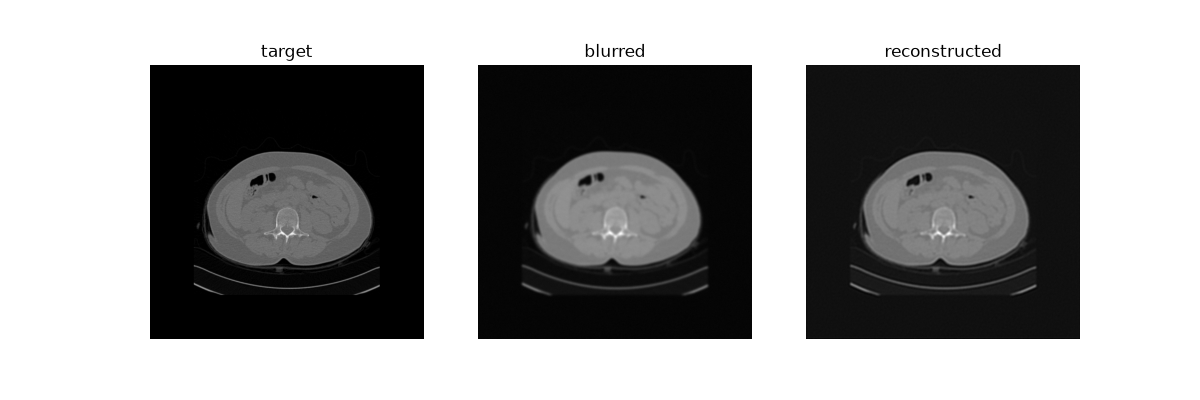
reconstructor = DataConsistent(blur, model)
blurred, image = validation[0]
deblurred = reconstructor.reconstruct(blurred)

fig, axes = plt.subplots(1, 3, figsize=(12, 4))
for ax, (title, x) in zip(
    axes, [("target", image), ("blurred", blurred), ("reconstructed", deblurred)]
):
    ax.imshow(x[0].cpu(), cmap="gray")
    ax.set_title(title)
    ax.axis("off")
A solver
A solver derives from LIONsolver and defines mini_batch_step(y,
target), the loss of one mini-batch (adding self._regularized(...)
for a model regularisation), and default_parameters(), its own settings.
E.g. a supervised solver with an L1 and a gradient-matching loss:
class EdgeSolver(LIONsolver):
    @staticmethod
    def default_parameters():
        return LIONParameter(edge_weight=0.1)

    def mini_batch_step(self, y, target):
        output = self._forward(y)
        edges = lambda x: x[..., 1:, :] - x[..., :-1, :]
        loss = self.loss_fn(output, target) + self.solver_params.edge_weight * (
            edges(output) - edges(target)
        ).abs().mean()
        return self._regularized(loss, y, output, target, self._forward)
The contributor guide has the rules, and a checklist for each piece, to add it to LION itself.
Total running time of the script: (1 minutes 1.555 seconds)