Note
Go to the end to download the full example code.
Self-supervised training
Clean images are rarely available for real scans. Self-supervised methods train from the noisy measurements alone, using what is known about the noise and the operator. LION has several, each a solver used like the supervised one: the model, the optimizer, the loss, the operator’s parameters and the solver’s own.
This tutorial trains with Noise2Inverse, then shows the others. A short run, to show how.
Previous: Supervised training. Next: Denoisers and Plug-and-Play.
Needs a GPU and the processed LIDC-IDRI data in LION_DATA_PATH.
Note
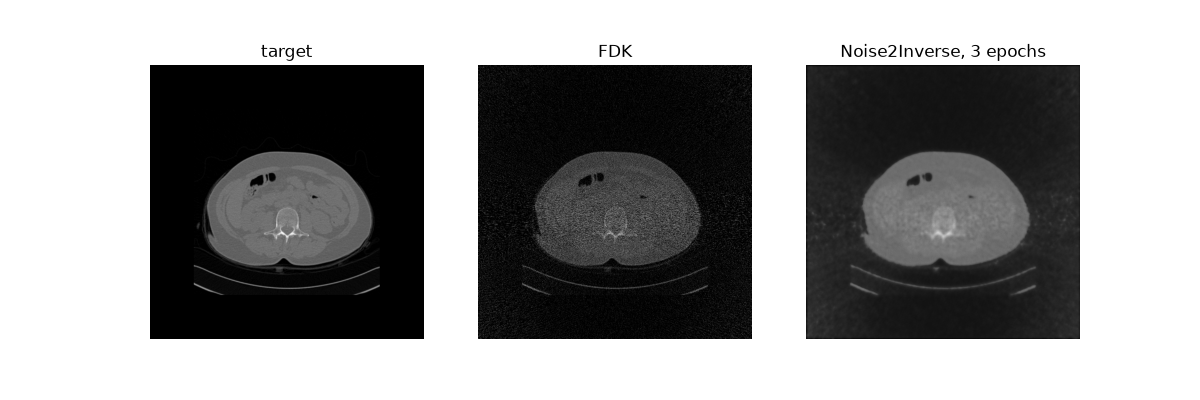
The models trained in these tutorials are toys: a few epochs on a few slices, to show how LION is used, so their results are poor (often worse than FDK). Trained as their papers train them (many epochs, all the data), they do what the papers report.
Noise2Inverse
Noise2Inverse (Hendriksen et al., 2020) splits the sinogram into sets of angles. Each set’s noise is independent of the others’, so a network trained to map the reconstruction of some sets to that of the others learns to remove the noise.
import tempfile

import matplotlib.pyplot as plt
import torch
from torch.utils.data import DataLoader, Subset

from LION.experiments import ct_experiments
from LION.metrics.psnr import PSNR
from LION.models.CNNs.UNets.Unet import UNet
from LION.optimizers.Noise2InverseSolver import Noise2InverseSolver

experiment = ct_experiments.LowDoseCTRecon()
training = Subset(experiment.get_dataset("train"), range(40))  # targets unused
validation = Subset(experiment.get_dataset("validation"), range(8))

training_loader = DataLoader(training, batch_size=2, shuffle=True)
validation_loader = DataLoader(validation, batch_size=2)
/mhome/damtp/r/ab2860/AItomotools/LION/data_loaders/LIDC_IDRI.py:487: UserWarning: LIDC-IDRI: left out 2 damaged or unusable files (re-run the pre-processing for these patients): ['LIDC-IDRI-0238 (not resampled)', 'LIDC-IDRI-0585 (not resampled)']
  warnings.warn(
The solver’s parameters say how to split: into sino_split_count sets of
every k-th angle, and which sets are the targets (cali_J). The paper’s
strategies are X:1 (each set in turn the target, the others the input) and
1:X (the reverse).
sino_split_count : 4
cali_J : None
recon_fn : default
[[1], [2], [3], [4]]
The model takes images (the reconstructions of the sets), so it has no operator: the solver needs the operator’s parameters, to split it.
model = UNet()
solver = Noise2InverseSolver(
    model,
    torch.optim.Adam(model.parameters(), lr=1e-3),
    torch.nn.MSELoss(),
    operator_params=experiment.operator_params,
    solver_params=parameters,
)
solver.set_training(training_loader)
Validation can still use clean images, if there are some, to measure how well it reconstructs (never to train): the solver validates its reconstruction.
solver.set_validation(validation_loader, 1, PSNR(), validation_fname="best")
solver.set_saving(tempfile.mkdtemp(), "Noise2Inverse")
solver.train(3)
print("validation PSNR:", solver.validation_loss)
solver.save_final_results()
validation PSNR: [21.66394997 18.75291038 19.0724206 ]
A Noise2Inverse reconstruction is the mean of the model’s outputs over the
splits: solver.reconstruct, not the model alone.
sinogram, image = validation[0]
with torch.no_grad():
    reconstruction = solver.reconstruct(sinogram[None])[0]

fig, axes = plt.subplots(1, 3, figsize=(12, 4))
shown = [
    ("target", image),
    ("FDK", solver.op.default_reconstruction(sinogram)),
    ("Noise2Inverse, 3 epochs", reconstruction),
]
for ax, (title, x) in zip(axes, shown):
    ax.imshow(x[0].cpu(), cmap="gray")
    ax.set_title(title)
    ax.axis("off")
The other self-supervised solvers
Each is used the same way; only its parameters differ. Each prints what it can be set to (and its paper’s values):
from LION.optimizers.Equivariance2InverseSolver import Equivariance2InverseSolver
from LION.optimizers.EquivariantSolver import EquivariantSolver
from LION.optimizers.Noisier2InverseSolver import Noisier2InverseSolver
from LION.optimizers.Proj2ProjSolver import Proj2ProjSolver
from LION.optimizers.Sparse2InverseSolver import Sparse2InverseSolver

for solver_class in [
    Sparse2InverseSolver,
    Noisier2InverseSolver,
    Proj2ProjSolver,
    EquivariantSolver,
    Equivariance2InverseSolver,
]:
    print(solver_class.__name__)
    print(solver_class.default_parameters())
Sparse2InverseSolver
sino_split_count : 4
input_split_count : 2
recon_fn : default
Noisier2InverseSolver
sigma : 3
delta : 1
recon_fn : default
Proj2ProjSolver
grid_size : 4
recon_fn : default
EquivariantSolver
transformation_group : <LION.optimizers.EquivariantSolver.RotationGroup object at 0x7f2a4358d400>
equivariance_strength : 100
Equivariance2InverseSolver
equivariance_strength : 1.0
noise_std : None
noise_kernel : None
recon_fn : default
E.g. equivariant imaging (Chen et al., 2021) learns from data consistency and from the reconstruction being equivariant to rotations:
solver = EquivariantSolver(
    model,
    torch.optim.Adam(model.parameters(), lr=1e-3),
    torch.nn.MSELoss(),
    operator_params=experiment.operator_params,
)
Some of these methods are only defined for the mean squared error: their
solvers train with it, and use loss_fn only to validate and test (they
warn if it isn’t the MSE).
Total running time of the script: (1 minutes 38.420 seconds)