Note
Go to the end to download the full example code.
Reconstructors
A reconstructor turns measurements into images with a trained model: the model inside an algorithm (a denoiser as a prior, a learned regulariser), or the model alone. It is made with everything that decides its result (the operator, the model and the algorithm’s settings), then run on data:
reconstructor = PnP(operator, model, parameters)
images = reconstructor.reconstruct(measurements)
So a reconstructor with its settings is one method: evaluations score it, records name it, and the same settings give the same result. This tutorial puts LION’s side by side, then saves one. Reconstructors are optional: a model can always be called directly (Supervised training).
Previous: Saving, loading and records. Next: Evaluation and comparison.
Needs a GPU and the processed LIDC-IDRI data in LION_DATA_PATH; the PnP
part downloads the authors’ trained DRUNet (130 MB).
Note
The models trained in these tutorials are toys: a few epochs on a few slices, to show how LION is used, so their results are poor (often worse than FDK). Trained as their papers train them (many epochs, all the data), they do what the papers report.
Classical reconstructions
The simplest are functions of the measurements and the operator (or its
parameters): fdk, sirt, tv_min for CT, and FISTA, conjugate
gradient and SPGL1 for any operator (LION.classical_algorithms).
Evaluations take such functions as methods too (Evaluation and comparison).
import tempfile
from pathlib import Path

import matplotlib.pyplot as plt
import torch
from torch.utils.data import DataLoader, Subset

from LION.experiments import ct_experiments
from LION.metrics.psnr import PSNR
from LION.operators.ct import fdk, sirt

experiment = ct_experiments.LowDoseCTRecon()
geometry = experiment.operator_params
sinogram, image = experiment.get_dataset("validation")[0]

reconstructions = {
    "FDK": fdk(sinogram, geometry),
    "SIRT": sirt(sinogram, geometry, num_iterations=100),
}
The forward reconstructor
ForwardReconstructor runs a model trained to reconstruct (FBPConvNet,
LPD, …) as its solver did: the initial reconstruction for image models,
the model’s normalisation, without gradients. Here a FBPConvNet trained for
a moment:
from LION.models.post_processing.FBPConvNet import FBPConvNet
from LION.optimizers.SupervisedSolver import SupervisedSolver
from LION.reconstructors.ForwardReconstructor import ForwardReconstructor

training = Subset(experiment.get_dataset("train"), range(40))
training_loader = DataLoader(training, batch_size=4, shuffle=True)

folder = Path(tempfile.mkdtemp())
fbpconvnet = FBPConvNet(geometry)
solver = SupervisedSolver(
    fbpconvnet, torch.optim.Adam(fbpconvnet.parameters()), torch.nn.MSELoss()
)
solver.set_training(training_loader)
solver.set_saving(folder, "FBPConvNet")
solver.train(2)
solver.save_final_results()

fbpconvnet, _, _ = FBPConvNet.load(folder / "FBPConvNet")  # from its file
forward = ForwardReconstructor(geometry, fbpconvnet)
reconstructions["FBPConvNet"] = forward.reconstruct(sinogram)
/mhome/damtp/r/ab2860/AItomotools/LION/data_loaders/LIDC_IDRI.py:487: UserWarning: LIDC-IDRI: left out 2 damaged or unusable files (re-run the pre-processing for these patients): ['LIDC-IDRI-0238 (not resampled)', 'LIDC-IDRI-0585 (not resampled)']
  warnings.warn(
Plug-and-Play
PnP uses a denoiser as the prior of an iterative algorithm (ADMM, HQS or
FBS). Here the DRUNet its authors trained on natural images in [0, 1], so the
images are normalised to [0, 1] for it (Denoisers and Plug-and-Play trains
one):
from LION.models.CNNs.drunet import DRUNet
from LION.reconstructors.PnP import PnP

denoiser = DRUNet.pretrained()
denoiser.set_normalisation("dataset", training)

parameters = PnP.default_parameters("ADMM")
parameters.max_iter = 20
parameters.noise_level = 10 / 255
pnp = PnP(geometry, denoiser, parameters)
reconstructions["PnP-ADMM"] = pnp.reconstruct(sinogram)
Learned regularisers
LearnedRegularizerReconstructor minimises ½||Ax - y||² + α R(x) by
gradient descent, for a regulariser R: a trained network
(Learned regularisers) or any function of an image, e.g. a
smoothed total variation:
def smoothed_tv(x, eps=1e-3):
    dx = x[..., 1:, :-1] - x[..., :-1, :-1]
    dy = x[..., :-1, 1:] - x[..., :-1, :-1]
    return torch.sqrt(dx**2 + dy**2 + eps**2).sum()


from LION.reconstructors.LearnedRegularizerReconstructor import (
    LearnedRegularizerReconstructor,
)

parameters = LearnedRegularizerReconstructor.default_parameters()
parameters.alpha = 10.0
parameters.n_steps = 50
regularised = LearnedRegularizerReconstructor(geometry, smoothed_tv, parameters)
reconstructions["smoothed TV"] = regularised.reconstruct(sinogram)
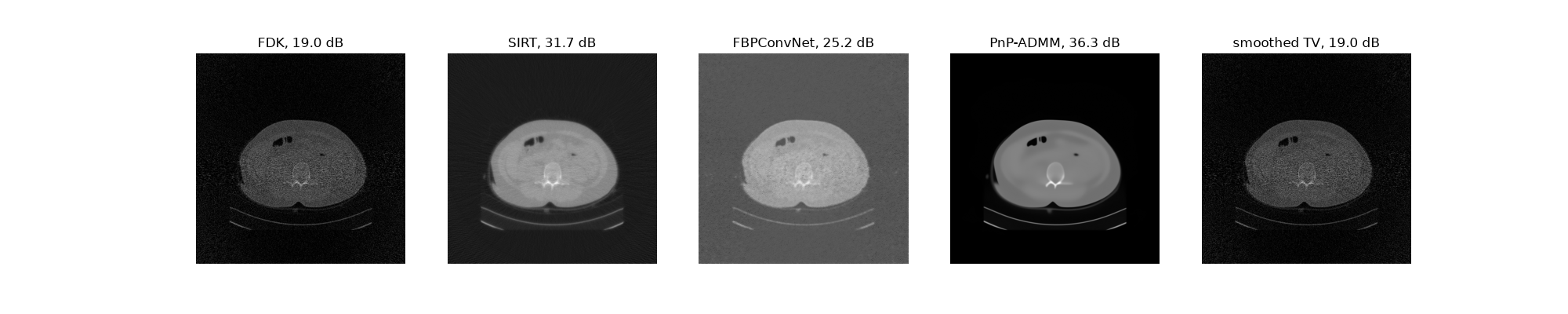
psnr = PSNR()
fig, axes = plt.subplots(1, len(reconstructions), figsize=(4 * len(reconstructions), 4))
for ax, (name, x) in zip(axes, reconstructions.items()):
    ax.imshow(x[0].cpu(), cmap="gray")
    ax.set_title(f"{name}, {psnr(x, image, batched=False):.1f} dB")
    ax.axis("off")
In a solver’s validation
A solver validates through a reconstructor when the model is used inside one: e.g. a learned regulariser’s (Learned regularisers), or a denoiser validated by its PnP reconstructions. The solver puts the model being trained into it:
Saving and loading
A reconstructor saves its settings and its model by the file it was loaded
from (the weights stay there); load makes both again. instantiate
makes it without its model, to give it another:
from LION.reconstructors.LIONreconstructor import LIONReconstructor

forward.save(folder / "FBPConvNet_reconstructor.json")
again = LIONReconstructor.load(folder / "FBPConvNet_reconstructor.json")
print(type(again).__name__, type(again.model).__name__)

other_model = FBPConvNet(geometry)
again = LIONReconstructor.instantiate(folder / "FBPConvNet_reconstructor.json")
again.model = other_model
/mhome/damtp/r/ab2860/AItomotools/LION/reconstructors/LIONreconstructor.py:211: UserWarning: the model given has other weights than the recorded one: the reconstructions won't be the recorded ones
  reconstructor = cls.instantiate(saved, model, allow=allow)
ForwardReconstructor FBPConvNet
Your own
A reconstructor derives from LIONReconstructor and defines
default_parameters() and reconstruct_sample(y, x0, verbose); the
tutorial Extending LION writes one.
Total running time of the script: (2 minutes 1.921 seconds)