Note
Go to the end to download the full example code.
Learned regularisers
A learned regulariser R is a network that scores images: low for clean ones, high for ones with noise and artefacts. Reconstruction then minimises a variational energy, data fit plus R,
as classical regularisation (e.g. TV) does with a hand-made R. This tutorial trains an adversarial regulariser (AR; Lunz, Öktem and Schönlieb, 2018) and reconstructs with it. Short runs, to show how.
Previous: Denoisers and Plug-and-Play. Next: Saving, loading and records.
Needs a GPU and the processed LIDC-IDRI data in LION_DATA_PATH.
Note
The models trained in these tutorials are toys: a few epochs on a few slices, to show how LION is used, so their results are poor (often worse than FDK). Trained as their papers train them (many epochs, all the data), they do what the papers report.
The regulariser
AR is a CNN from an image to a number. It takes images of the operator’s domain shape, so it takes the operator’s parameters.
import tempfile

import matplotlib.pyplot as plt
import torch
from torch.utils.data import DataLoader, Subset

from LION.experiments import ct_experiments
from LION.metrics.psnr import PSNR
from LION.models.learned_regularizer.AR import AR
from LION.operators.ct import fdk

experiment = ct_experiments.LowDoseCTRecon()
training = Subset(experiment.get_dataset("train"), range(40))
validation = Subset(experiment.get_dataset("validation"), range(4))

training_loader = DataLoader(training, batch_size=4, shuffle=True)
validation_loader = DataLoader(validation, batch_size=1)

regulariser = AR(experiment.operator_params)
print(regulariser.cite("MLA"))
/mhome/damtp/r/ab2860/AItomotools/LION/data_loaders/LIDC_IDRI.py:487: UserWarning: LIDC-IDRI: left out 2 damaged or unusable files (re-run the pre-processing for these patients): ['LIDC-IDRI-0238 (not resampled)', 'LIDC-IDRI-0585 (not resampled)']
  warnings.warn(
Lunz, Sebastian, Ozan Öktem, and Carola-Bibiane Schönlieb
"Adversarial regularizers in inverse problems."
neural information processing systems 31 (2018).
arXiv:2008.02839 (2020).
Training: clean images against reconstructions
ARSolver trains R as a critic (a Wasserstein GAN loss with a gradient
penalty, lambd_gp): it learns to tell the clean images from the
reconstructions of the measurements (FDK, the operator’s default). It has no
loss argument: the loss is the method’s.
from LION.optimizers.AdversarialRegularizerSolver import ARSolver

print(ARSolver.default_parameters())

solver = ARSolver(
    regulariser,
    torch.optim.Adam(regulariser.parameters(), lr=1e-4, betas=(0.5, 0.99)),
)
solver.set_training(training_loader)
lambd_gp : 0.1
recon_fn : default
The WGAN loss doesn’t say how good the reconstructions are, so validation
reconstructs with the regulariser being trained: through a reconstructor you
make, with its own settings, given to set_validation.
from LION.reconstructors.LearnedRegularizerReconstructor import (
    LearnedRegularizerReconstructor,
    estimate_alpha,
)

# the paper's weight: the mean size of the data fit's gradient at the
# reconstructions
alpha = estimate_alpha(experiment.operator_params.make_operator(), training_loader)
print(f"alpha = {alpha:.3g}")

reconstructor_parameters = LearnedRegularizerReconstructor.default_parameters()
reconstructor_parameters.alpha = alpha
reconstructor_parameters.n_steps = 50
reconstructor = LearnedRegularizerReconstructor(
    experiment.operator_params, regulariser, reconstructor_parameters
)
print(reconstructor_parameters)

solver.set_validation(
    validation_loader,
    1,
    PSNR(),
    validation_fname="AR_best",
    reconstructor=reconstructor,
)
solver.set_saving(tempfile.mkdtemp(), "AR")
solver.train(3)
solver.save_final_results()
alpha = 2.7e+05
alpha : 270297.3154296875
n_steps : 50
step_size : 1e-06
backtracking : 0.95
initial_reconstruction : <function fdk at 0x7f2b3c260220>
Reconstructing
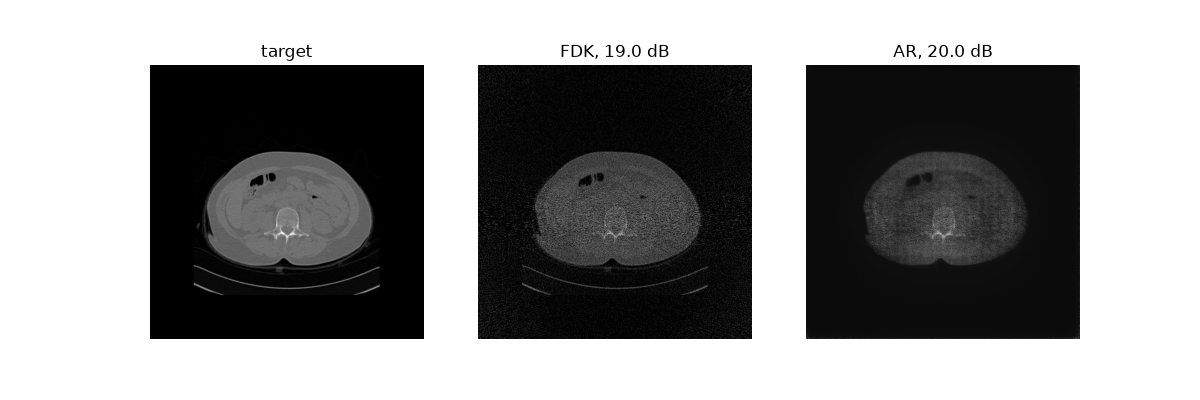
Gradient descent on the energy, from FDK, with a backtracking step size:
sinogram, image = validation[0]
reconstruction = reconstructor.reconstruct(sinogram)

psnr = PSNR()
fbp = fdk(sinogram, experiment.operator_params)
fig, axes = plt.subplots(1, 3, figsize=(12, 4))
shown = [
    ("target", image),
    (f"FDK, {psnr(fbp, image, batched=False):.1f} dB", fbp),
    (f"AR, {psnr(reconstruction, image, batched=False):.1f} dB", reconstruction),
]
for ax, (title, x) in zip(axes, shown):
    ax.imshow(x[0].cpu(), cmap="gray")
    ax.set_title(title)
    ax.axis("off")
Other regularisers
The reconstructor works with any regulariser, however it was trained: a LION model, or any function of an image. The adversarial convex regulariser (ACR; Mukherjee et al., 2021) is trained the same way and is convex in the image, so the energy has a single minimum:
from LION.models.learned_regularizer.ACR import ACR
regulariser = ACR()
Hand-made ones too, e.g. a smoothed total variation:
def smoothed_tv(x, eps=1e-3):
    dx = x[..., 1:, :-1] - x[..., :-1, :-1]
    dy = x[..., :-1, 1:] - x[..., :-1, :-1]
    return torch.sqrt(dx**2 + dy**2 + eps**2).sum()


tv = LearnedRegularizerReconstructor(
    experiment.operator_params, smoothed_tv, reconstructor_parameters
)
Total running time of the script: (2 minutes 25.309 seconds)